Check your Schufa for free
Three methods, step-by-step – and when you actually need the paid version
Since March 2026 there are now three ways to access your Schufa data without paying anything. But there is also one situation where you genuinely do need to spend 29.95 EUR. This guide explains all three free methods with exact steps, what each one shows, and when the paid version is unavoidable.
There is a lot of confusion about Schufa costs. The Schufa's own website prominently advertises a paid service (BonitätsCheck) for 29.95 EUR. But you are legally entitled to access your Schufa data for free, and since March 2026 that access has become easier than ever. The trick is knowing which free option to use, and when the paid version is genuinely necessary.
The three free methods at a glance
1 Free Schufa Account (app.schufa.de)
The Schufa launched its free digital consumer account on 17 March 2026. For the first time, you can see the same score that lenders and landlords see, broken down by all 12 criteria, at any time and without charge. Setup takes about 10 minutes and requires a one-time identity verification.
Step-by-step: Set up your free Schufa Account
The Schufa Account portal. On a mobile device, you can also download the Schufa app from the App Store or Google Play. Use your browser's translation function if you need English.
Create a free account with your email and a password. You will receive a confirmation email to verify the address.
Because the Schufa handles sensitive personal financial data, a one-time identity check is required. Accepted methods include: the German eID (Online-Ausweisfunktion), a VideoIdent procedure (camera-based), or the AusweisApp2. A valid passport is accepted in the VideoIdent process, which works for non-EU nationals too.
Once verified, you immediately see your current score (100–999), all 12 criteria with your individual point values, a full list of all stored contracts and entries, and the Score Simulator for testing hypothetical decisions.
2 Free Datenkopie by post (Art. 15 GDPR)
This is your oldest and most comprehensive legal right. Under Article 15 of the GDPR, every person is entitled to a free copy of all data an organisation holds on them. The Schufa calls this the "Datenkopie nach Art. 15 DSGVO". It is not advertised prominently on the Schufa website, but it is legally guaranteed and cannot be refused.
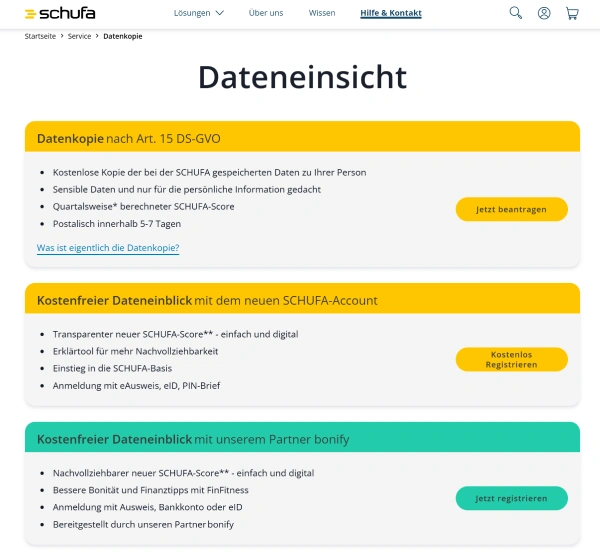
Screenshot: meineschufa.de/service/datenkopie – the free Datenkopie option is found under "Datenkopie nach Art. 15 DSGVO", below the paid products.
Step-by-step: Request the free Datenkopie
Navigate directly to meineschufa.de/datenkopie or search for "Datenkopie nach Art. 15 DSGVO" on the site. Ignore the BonitätsCheck product page.
Enter your full name, date of birth, current German address, and previous address if you have moved recently. The more accurate the data, the faster the processing.
You will be asked to upload a copy of a valid ID document (passport or German ID card). The Verbraucherzentrale advises that you should only provide an ID copy if your address differs from what the Schufa has on file, as it is not legally required otherwise. In practice, uploading a passport scan is the fastest way to proceed.
The Datenkopie is sent exclusively by post to your registered German address. Delivery typically takes 2 to 4 weeks. Make sure your registered address (Anmeldeadresse) is up to date before applying.
The letter contains: all data the Schufa holds on you (accounts, loans, contracts, enquiries), your current score, a list of who has queried your data in the last 12 months, and information on where each data point came from. Check every entry for accuracy.
3 Bonify app (free basic access)
Bonify is a financial app that the Schufa acquired in 2022. It offers free score access with a simpler sign-up than the full Schufa Account. Since July 2023, it has shown the official Schufa Basisscore and, since March 2026, it also displays data linked to the new 12-criterion system. The app is available on iOS and Android.
What Bonify shows (free tier):
Free vs. paid: what is the difference?
The single most important thing to understand is that the free and paid Schufa products serve completely different purposes. The free options are for your own information. The paid Bonitätsauskunft is the document you give to someone else.
| Feature | Schufa Account Free |
Datenkopie Free |
Bonitätsauskunft 29.95 € |
|---|---|---|---|
| Shows your current score | |||
| All 12 score criteria breakdown | |||
| Full list of stored entries | |||
| Who queried your data (last 12 months) | |||
| Accepted by landlords | |||
| Available as instant PDF | |||
| Delivery time | Instant | 2–4 weeks | Instant (PDF) |
| Score Simulator |
When do you actually need to pay 29.95 EUR?
There is exactly one situation where the paid Bonitätsauskunft is necessary: when a landlord, a bank, or another third party explicitly asks for an official Schufa creditworthiness certificate. This document has a verification code, is formatted as a clean certificate, and shows only the information relevant to creditworthiness without exposing your full financial history.
- Checking your own score
- Finding out what data is stored about you
- Monitoring your score over time
- Preparing to dispute an error
- General score awareness before applying for a loan
- A rental application where the landlord requests a Schufa Bonitätsauskunft
- Any situation where you need an official, verifiable certificate to hand to a third party
How to dispute a wrong Schufa entry
Schufa data is not infallible. Common errors include debts that have been paid but not updated, contracts belonging to a different person with a similar name, outdated address data, and enquiries that were never authorised. Under GDPR, you have the right to have incorrect data corrected or deleted, free of charge.
You need the full data picture to identify what is wrong. Use the free Schufa Account or request the Datenkopie. Note the exact wording of the entry you want to dispute, including the creditor's name and the date.
State clearly which entry is incorrect, why it is incorrect, and what correction you request. Include proof where possible: a payment receipt, a court document, a letter from the creditor confirming settlement. Send by post or email: meineschufa@schufa.de / SCHUFA Holding AG, Postfach 10 25 66, 44725 Bochum.
The Schufa received the entry from a creditor (bank, telecom, debt collector). Writing to both simultaneously speeds up the process. The creditor must confirm, correct, or withdraw the data. Without confirmation, the Schufa cannot keep the entry.
The Schufa is legally required to investigate and respond within four weeks. During the investigation, the disputed entry is typically marked as contested. If the investigation confirms your objection, the entry is corrected or deleted.
The Schufa is regulated by the Hessischer Beauftragter für Datenschutz und Informationsfreiheit (HBDI) in Wiesbaden, because the Schufa is based in Hessen. If the Schufa rejects your objection and you believe the entry is still wrong, you can file a free complaint at datenschutz.hessen.de.
The faster deletion rule (new from 2026)
Under the 2026 reform, a specific rule now applies to small debts that are quickly settled: if you pay an outstanding debt within 100 days of the first missed payment, the negative entry must be deleted after 18 months rather than the previous 3 years. This applies to debts that are paid in full, not just partially.
| Entry type | Deletion after |
|---|---|
| Debt paid within 100 days of first default | 18 months after payment (new 2026) |
| Debt paid after 100+ days | 3 years after payment |
| Fully repaid instalment loan | 3 years after repayment |
| Lender credit enquiry (hard) | 12 months visible, 10 days affecting score |
| Insolvency proceedings | 3 years after discharge |
| Bank account (positive) | 3 years after closing |
Frequently asked questions

As the founder of Bankdaten.de and other financial portals, I have been dealing with banks, investment accounts, and interest conditions on a daily basis – both personally and professionally – for more than 25 years.